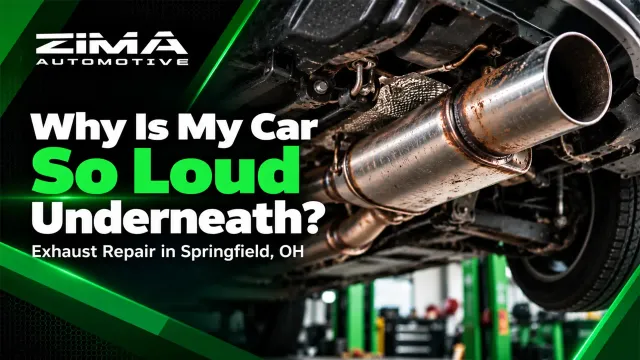
A car that suddenly sounds loud underneath often has an exhaust leak, a loose part, or damage to the muffler or pipe. The sound may be a deep roar, a sharp tick, or a metallic rattle. Winter salt can encourage corrosion, while Springfield potholes can stress low-mounted hangers, clamps, and shields. These conditions can contribute to exhaust problems, but the sound alone cannot confirm the cause.
If you need
exhaust repair in Springfield, OH, we can inspect the full system, identify the source of the noise, and recommend the appropriate repair.
Why a Car Gets Loud Underneath
A car gets loud underneath when exhaust gases escape before reaching the tailpipe or when a loose component vibrates against the body. Several parts can create similar sounds, so location and timing matter.
Exhaust Leaks and Cracked Pipes
An exhaust leak can sound like ticking, puffing, hissing, or roaring. Small leaks near the engine are often sharper and may speed up with engine RPM. A split pipe or failed joint farther back usually creates a deeper, louder exhaust noise.
Condensation and Ohio road salt can corrode pipes from both sides. Exhaust leak repair starts by locating the opening instead of assuming the muffler is responsible.
Loose Heat Shields, Hangers, and Clamps
Loose hardware usually creates a metallic buzz or rattle rather than a steady roar. Heat shields can corrode around their mounting points, and rubber hangers can stretch or split. A weak hanger lets the pipe swing and tap the body, especially over Springfield potholes or uneven railroad crossings.
Muffler and Resonator Damage
A damaged muffler or resonator often creates a deeper sound across many speeds. Internal baffles can rattle even when the shell looks intact. Not every car that sounds loud underneath needs a muffler, so the full system should be checked first.
Catalytic Converter Problems
A catalytic converter may rattle if its internal material breaks apart. Restriction can reduce power or trigger a warning light, but noise alone does not prove converter failure.
Some converter-related faults begin with an engine problem, such as a misfire or incorrect fuel mixture. Our engine diagnostic service can help identify an underlying performance issue before it damages a replacement part.
How the Sound and Timing Narrow Down the Cause
The most useful clue is when the noise happens, such as during a cold start, acceleration, idle, bumps, or cruising on I-70 or US-40.
Noise During Startup or Acceleration
Cold-start ticking may point to a manifold or gasket leak that quiets as metal expands. A roar that grows with acceleration often suggests a larger leak farther under the car.
Loss of power, poor fuel economy, or a check engine light adds another clue. The same diagnostic approach applies to many domestic vehicles, including the Chevrolet vehicles we service, because sound and scan data must be considered together.
Rattling at Idle or Over Bumps
An idle rattle often comes from a loose shield, broken hanger, or muffler damage. A clunk over bumps can mean the exhaust is contacting the body or another bracket.
If the noise started after hitting a pothole, check the ground for fresh fluid as well. A noise and a puddle may be separate problems, and our guide to coolant leaking under your car explains how to recognize a cooling-system leak. Do not crawl beneath a vehicle supported only by a jack.
Is It Safe to Drive With a Loud Exhaust?
A new exhaust noise should be inspected soon, and some symptoms mean you should stop driving. Pull over in a safe place if fumes enter the cabin, you feel dizzy or nauseated, power drops sharply, or a pipe hangs close to the road.
Carbon monoxide has no color, smell, or taste. Ohio driver training guidance recommends checking the exhaust system regularly and getting immediate medical attention if exposure affects you. An exhaust odor can come with other gases, but the absence of odor does not rule out carbon monoxide.
What an Exhaust Inspection Should Check
An exhaust system repair inspection should follow the system from engine to tailpipe. The technician checks for soot, corrosion, loose joints, failed gaskets, broken hangers, damaged shields, and internal rattles.
Warning lights and drivability changes also matter. Smoke testing, listening tools, scan data, or temperature checks may help. At Zima Automotive, we explain what failed and which repair fits the vehicle's condition.
Takeaways
A loud sound underneath usually points to an exhaust leak, loose hardware, muffler damage, or a converter problem. The sound's timing and tone can narrow the possibilities, but similar noises often overlap.
Schedule an inspection when the noise is new, worsening, or paired with fumes, a warning light, reduced power, or a hanging part. Early diagnosis can protect the vehicle and keep exhaust gases routed away from the cabin.
Frequently Asked Questions
Why did my car suddenly get louder underneath?
Your car may have developed an exhaust leak, a broken hanger, a loose shield, or damage to the muffler or pipe. A sudden change after hitting road debris or a pothole can also point to impact damage beneath the vehicle.
Does a loud car always need a new muffler?
No, a loud car does not always need a new muffler. A leaking gasket, cracked pipe, loose clamp, heat shield, or failed hanger can create similar noise, so the full system should be inspected first.
Can an exhaust leak turn on the check engine light?
Yes, an exhaust leak can contribute to a check engine light when it affects oxygen-sensor readings or system performance. The stored fault code and test results should guide the repair because a warning light can have other causes.
How long can I drive with an exhaust leak?
Driving with an exhaust leak is not recommended because there is no reliable safe mileage or time limit. Arrange an inspection promptly, and stop driving if fumes enter the cabin, the car loses power, or a loose part could contact the road.
What does exhaust repair usually involve?
Exhaust repair usually involves finding the leak or loose component, checking related damage, and repairing or replacing the affected part. The work may involve a gasket, clamp, hanger, pipe, muffler, resonator, or catalytic converter, depending on the inspection.
Schedule Exhaust Repair in Springfield, OH
If your car is roaring, ticking, or rattling below the floor, contact Zima Automotive for an inspection. You can request a service appointment or call (937) 342-3911 to describe when the noise happens.
Our shop is at
4800 Urbana Rd, Springfield, OH 45502, with convenient access for drivers from Springfield, Urbana, Mechanicsburg, Enon, and nearby Clark County communities. We will trace the noise, show you what we find, and explain the next step for your vehicle.